
Most businesses that struggle with their operations aren't short on tools. They're short on sequence.
They've invested in platforms, hired consultants, gone through implementation projects. But the systems never quite land. Adoption is partial. The team has workarounds. The reporting still doesn't show what anyone actually needs to see.
The problem, almost always, is that the implementation happened before the foundation was solid. The right tools were chosen (or the wrong ones were), but the process work that should have preceded the build wasn't done.
This post is about what the right sequence actually looks like, why it matters, and how to know whether you're ready to start.
Key takeaways
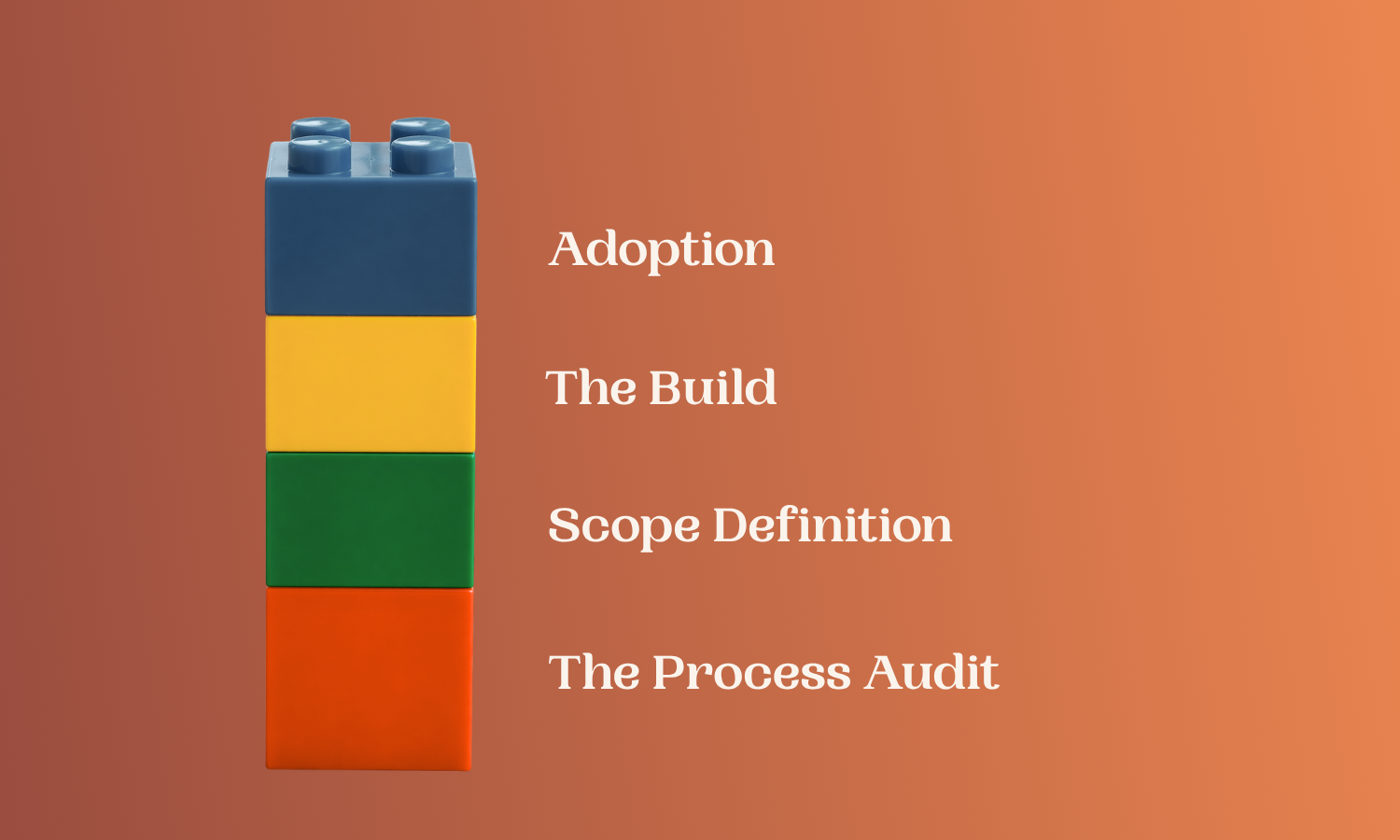
- A successful implementation follows four steps in order: process audit, scope definition, build, adoption. Skipping or shortcutting any of them increases the risk of failure.
- The most common point of failure is between scope and build, where urgency pushes a project into implementation before requirements are fully agreed on.
- User adoption is not a separate phase that happens after implementation. It starts at the discovery stage, when the people who'll use the system are first involved.
- A system that's technically live but not fully used is not a successful implementation.
- The businesses that invest in getting the sequence right spend less overall and end up with systems that stick.
Why sequence matters more than tool selection
When an operations project fails to deliver, the conversation usually turns to the tool. The platform wasn't right. The vendor overpromised. The system was too complex.
Sometimes that's true. But in most cases, the tool wasn't the primary problem. The sequence was.
70% of software implementations fail primarily due to poor user adoption, not technical failure. The system works as designed. People just don't use it, because they weren't part of designing it, because the system doesn't reflect how they actually work, or because the training was insufficient to bridge the gap.
This is fixable. But fixing it after an implementation is far more expensive than preventing it by getting the sequence right from the start.
Step one: the process audit
Before anything else, you need an accurate picture of how the business actually operates today.
Not the ideal version. Not the version that's been aspirationally documented somewhere. The real one, including the workarounds, the exceptions, the steps that happen because a specific person knows something nobody else does.
This is process mapping in practice: a structured conversation with the people doing the work at each stage, walking through exactly what happens, and asking why at every turn.
The audit produces three things: a current-state picture, a list of what's missing or broken, and the beginning of a shared understanding across the team about how the business works. That shared understanding is the most valuable output, because it's what makes every subsequent decision easier.
Step two: scope definition
Once you have a clear picture of the current state, you can define what needs to change.
This is the step most businesses rush through. There's momentum from the audit, there's excitement about the solution, and the instinct is to move quickly to the build. Resisting that instinct is one of the most important things you can do.
A proper scope definition answers these questions:
What are we changing, and what are we leaving alone? Not everything is broken. A scope that tries to fix everything at once is a scope that will expand continuously. Being specific about what's in and what's out protects the project.
What does success look like? Concrete, specific, measurable. Not "better reporting" but "a weekly dashboard showing revenue by client, with drill-down by service type." Vague success criteria are how projects end up running for years without a clear end point.
What are the dependencies? If this system needs to connect to three other tools, those integrations need to be scoped alongside the build. Understanding your integration requirements before you start is non-negotiable.
Who needs to sign off? A scope that the founder has agreed to but the operations team hasn't seen will produce surprises during implementation. Getting agreement from the people who'll live with the system before the build starts is how you prevent the most expensive scope changes.
78% of software projects experience scope creep, most often because the requirements weren't fully agreed before implementation began. A proper scope definition is the primary tool for preventing this.
Step three: the build
With a clear process and an agreed scope, the implementation work can proceed in the right order.
A few principles that make the build phase more likely to succeed:
Build around the process, not the other way around. The system should reflect how the work actually flows, with the right information surfacing to the right person at the right time. If you find yourself asking people to change how they work to fit the system, that's a sign the system wasn't designed with enough input from the people using it.
Build in phases. An implementation that tries to deliver everything at once is much harder to manage than one that delivers a working foundation first and layers complexity on top. Getting something usable into people's hands early creates feedback opportunities that improve the final result.
Document as you go. The decisions made during a build are easy to forget, and they matter enormously when something needs to change later. A well-documented system is one that a new team member can pick up without six months of institutional knowledge transfer.
Test with real workflows, not hypothetical ones. The edge cases that will break a system are the ones that come from the actual day-to-day exceptions in your business. Test those specifically, not just the clean, standard path.
Step four: adoption
This is where most implementations stop short.
Adoption isn't a training session. It's not a Loom video and a process doc. It's an ongoing commitment to ensuring the people using the system understand why it works the way it does, and that they have a way to surface problems when things don't fit.
The businesses that get adoption right do a few things consistently:
They involve the team before the build. When people were part of the discovery process, when their input shaped the system, they feel ownership over it. That ownership translates to usage. Systems built on top of people rather than with them get worked around.
They treat the first few months as a feedback loop. A newly implemented system will surface things that weren't anticipated in the scope. That's normal. Having a clear channel for the team to raise those issues, and a process for addressing them quickly, is what separates a system that matures and improves from one that calcifies at whatever state it was in on launch day.
They connect the tool to the outcome. People use tools that make their work easier. If a team member can't articulate how the new system saves them time or reduces errors compared to what they were doing before, they'll revert. Making that connection explicit, ideally in the training phase, is an important part of overcoming team resistance to workflow improvements.
Where the sequence most commonly breaks down
The most common failure point isn't the audit and it isn't the build. It's the gap between scope definition and the start of implementation.
The audit is done. There's clarity. There's a plan. And then the urgency of the business takes over. The project needs to be done before a particular deadline. A new hire is starting who needs the system. The founder wants to see progress.
And so the implementation begins before the scope is fully locked. Requirements surface during the build that should have been in the scope. The timeline extends. The budget grows. The team loses confidence in the process.
40-50% of software projects are delivered later than their original timeline, with scope changes during implementation as the primary cause. The businesses that beat those odds are the ones that hold the line on scope definition before allowing the build to start.
How to know if you're ready to start
You don't need your processes to be perfect before starting an operations improvement project. If they were, you probably wouldn't need the project.
What you do need is:
The right people available. The person with the overall vision. The person who handles the operational detail day to day. The person who manages the specific function that's causing the most friction. Not necessarily all in the same meeting, but accessible.
A willingness to surface what's actually happening. The audit only works if the people involved are honest about the current state, including the parts that aren't working well. Defensiveness about existing processes is the biggest obstacle to getting a useful picture.
Agreement that process comes before technology. If the project is going to start with a tool evaluation rather than an audit, the sequence is already wrong. The decision about which tool to use should follow the process work, not precede it.
If you have those three things, you're ready. The rest is the work.
Conclusion
The businesses that end up with systems that work aren't the ones that found the best tools. They're the ones that did the foundational work first: understanding their current operations, defining what needed to change, and building with their team rather than on top of them.
The sequence isn't complicated. It's just discipline, at the point where most projects want to skip ahead.
Get the foundation right, and the rest of the work goes faster and sticks longer. That's the whole principle.
FAQ
What is systems implementation in a business context? Systems implementation is the process of introducing new tools, workflows, or processes into a business's operations. It includes the design, configuration, testing, and rollout of the new system, as well as the training and change management required to get the team using it effectively.
Why do so many business systems fail to get adopted after implementation? The most common reason is that the people who need to use the system weren't involved in designing it. When a system is built without the input of the people doing the work, it doesn't fit how the work actually happens. That mismatch creates friction, and friction leads to workarounds. Addressing team resistance proactively is one of the most important parts of any implementation project.
How long should a systems implementation take? It depends on the complexity of the scope. For a small to mid-sized business with a clearly defined process, a well-scoped implementation of a core operational system typically takes weeks to a few months. Projects that run significantly longer are usually a sign that scope wasn't clearly defined before the build started.
What is scope creep, and how do I prevent it? Scope creep is the expansion of a project's requirements during implementation, beyond what was originally agreed. It happens when requirements aren't fully defined before the build starts, so they surface during it instead. The best prevention is a thorough scope definition phase before any implementation work begins, with written agreement from all key stakeholders on what's included and what isn't.
Do I need a consultant to implement business systems? Not always. For simple, well-documented processes and straightforward tools, an internal team can often handle implementation. Where a consultant adds the most value is in the discovery and process mapping work that precedes the build, in tool selection where domain expertise reduces the risk of a poor fit, and in complex implementations where the integration requirements or the organizational change management are significant.
What's the difference between systems implementation and workflow automation? Systems implementation is the broader process of introducing and embedding a new tool or process into the business. Workflow automation is a specific type of systems work focused on replacing man**l steps with automated ones. Automation is often one component of a larger implementation project, not a standalone solution.
.png)
.png)
.png)


