
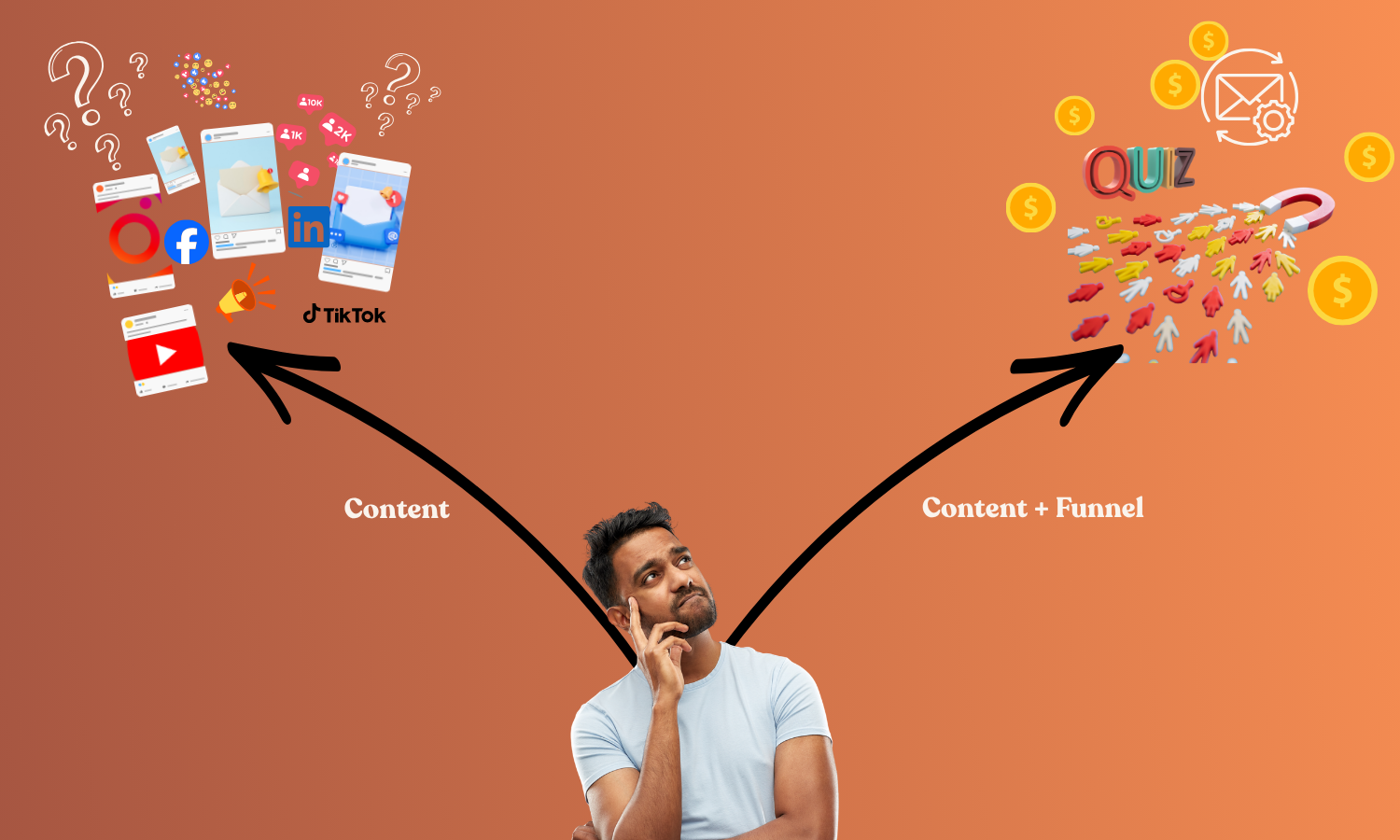
Most service-based founders treat content the way they treat their first hire. They wait too long, then move too fast, then wonder why it is not working.
The version of this mistake I see most often is the order of operations. A founder reads an article about building a personal brand. They hear that referrals are not a strategy. They decide the answer is to publish more. So they fire up a content calendar, commit to two LinkedIn posts a week, start a newsletter. Maybe they hire a ghostwriter or use a tool that turns their meetings into drafts.
Then nothing happens.
The posts get likes. The newsletter picks up a few subscribers. A handful of conversations start. But the pipeline does not move.
What is missing is the destination. The content has nowhere to send people.
Companies with documented sales funnels are significantly more likely to convert content readers into qualified pipeline than companies relying on ad-hoc capture. The reason is not that one group writes better posts. It is that one group built the road before they built the car.
What a destination actually looks like
A destination is not just a website. A website is necessary but not sufficient. What you need is a path that a reader can walk down without you in the room.
A workable path has four parts.
First, a landing page tied to a specific outcome. Not your home page. A page that promises one useful thing to one specific person. The home page is the lobby. The landing page is the room you actually want them in.
Second, a short interaction on that page. Usually a quiz, an assessment, or a short calculator. Five to ten questions designed to deliver an insight on the spot. The visitor should walk away with something useful inside sixty seconds, before any email is requested.
Third, a deeper version of the insight in exchange for an email. This is the lead magnet. If the on-page interaction was a five-question diagnostic, the lead magnet is a longer report tailored to their answers. It is not a generic PDF. It is the next step in a real conversation.
Fourth, a welcome sequence that picks up where the lead magnet ended. Three to seven emails that continue the thread, teach something specific, and move the reader closer to a clear next step. This is where most people quit too early. The welcome sequence is the part that converts curious readers into serious buyers.
Why content without this architecture fails
Without a destination, content does the same thing referrals do. It sends warm strangers into your inbox. That works at low volume. At higher volume, it does not. Replies get missed. Context gets lost. Sundays get spent cleaning up the CRM.
Content with a destination automates the part that referrals could never automate. The follow-up. The qualification. The drip of value that turns a curious reader into a buyer over weeks, not minutes.
The destination is the leverage. The content is the traffic. Treating them in the opposite order is what makes founders feel like content does not work.
The copy layer most templates skip
There is one more layer that decides whether the path converts or just exists.
The copy on every step should use the words your past clients have actually used. Not your words. Theirs.
The way to get there is to talk to people. Get on calls with three to five past clients. Have a copywriter run the conversations if you can. Ask questions that lead them to describe in their own words what they felt before they hired you, what shifted during the work, and how they would describe the result to a friend.
Then write the landing page, the lead magnet, and the welcome sequence using those exact phrases.
The test for whether the copy is working is simple. If a stranger lands on the page and says some version of "how did you know I felt that way," the voice-of-customer work is doing its job. If a stranger lands on the page and shrugs, the copy is still in your voice instead of theirs.
Brand voice is what you sound like when you talk to other consultants. Customer voice is what your buyer sounds like when they describe their own problem. Only one of those converts.
What to do before you write another post
If you are about to invest in content, run this checklist first.
❓Is there a landing page tied to one specific outcome?
❓Does the page deliver something useful before asking for an email?
❓Is there a lead magnet that picks up where the on-page interaction ends?
❓Is there a welcome sequence behind the email capture?
❓Has the copy on each step been written using the actual phrases your past clients have used?
Only when those five exist should you scale a content engine.
The integrations come after. The CRM, the project management tool, the accounting connections, the analytics dashboards. All of that is real work. But it is work that pays off once the destination exists and the funnel can carry weight.
The takeaway
Content is a multiplier. It multiplies whatever exists. If the destination is sharp, content makes it sharper. If the destination is missing, content multiplies zero.
If you are about to launch a content engine, write the destination first.
The posts can wait a week.
.png)
.png)
.png)


