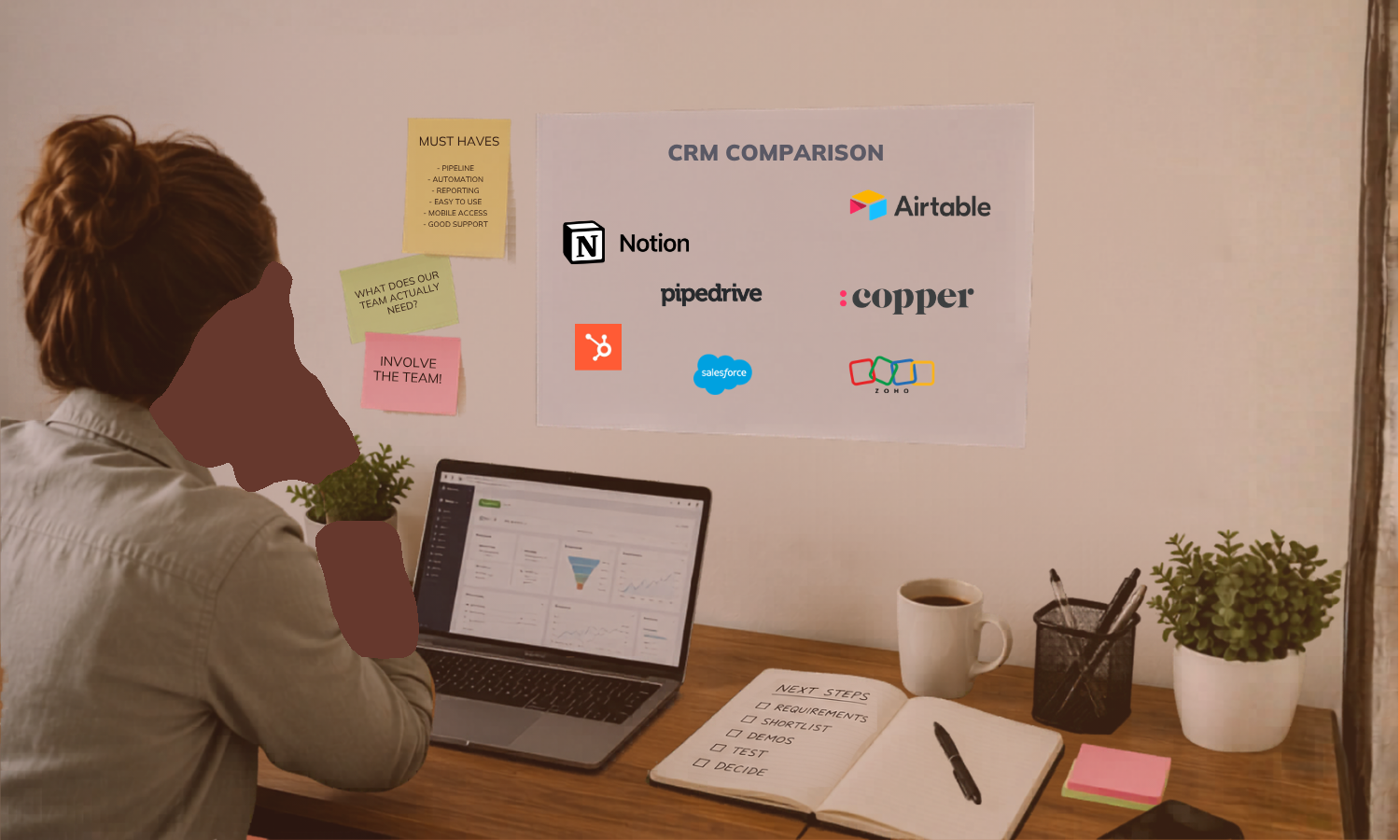
There's a particular kind of tech decision that feels responsible when you make it and expensive when you live with it.
You've outgrown spreadsheets. You need something real. A consultant, a peer, or a vendor demo points you toward an enterprise platform, the kind used by large organizations, the kind that can "grow with you" and handle anything you throw at it.
So you sign up. You invest in the setup. You hire someone to configure it or pay an agency to do it for you.
And then it's heavy. Slow to learn. Hard to adapt. Full of features you'll never use. And your team, quietly, has started working around it.
This article is about why that happens, how to recognize when a tool is built for someone else's business, and what to look for instead.
Key takeaways
- Enterprise software is built for enterprise complexity. For small and scaling businesses, that complexity often becomes a liability.
- The cost of a complex platform isn't just the license fee. It includes implementation, training, maintenance, and the ongoing drag of a tool your team doesn't fully use.
- "Robust" and "right for you" are not the same thing.
- Sunk cost is not a reason to stay with a tool that isn't working.
- The right tool for your business is the simplest one that handles your actual, documented requirements, not your hypothetical future ones.
The prestige problem
Some software categories carry a status signal. Using certain platforms tells the world, or at least your industry peers, that your business is serious. That you've arrived.
The problem is that status isn't the same as fit.
Enterprise platforms are built for enterprise problems. They're designed to be flexible enough to serve enormous, complex organizations across multiple departments, geographies, and use cases. That flexibility is genuinely impressive. It's also the source of the problem for smaller businesses, because the flexibility is complexity, and complexity has to be managed by someone.
For a business with a dedicated technical team, a documented set of processes, and the budget to invest in a proper implementation and ongoing maintenance, that complexity pays off. For a scaling service business with a lean team that needs to move fast, it often doesn't.
(This is closely related to the broader question of whether all-in-one tools are the right choice for your business at this stage of growth. But that’s a whole different discussion.)
What enterprise software actually costs
The license fee is rarely the most expensive part of an enterprise platform adoption.
The real costs are:
Implementation. Configuring a flexible system to match a specific business requires expertise, and that expertise isn't cheap. Implementation projects regularly run over time and over budget. In fact, more than 70% of technology implementations fail to reach their original business case goals, most often because the scope wasn't clearly defined before the build began.
Training. Every new team member faces a learning curve. With a highly configurable system, that curve is steep and ongoing. The cost isn't a one-time event. It recurs every time someone joins the team or the configuration changes.
Maintenance. Custom fields, workflow rules, and integrations need to be maintained. If the person who built them leaves, that knowledge often leaves with them. Rebuilding it from scratch is expensive.
Lost productivity. A tool your team works around rather than with is costing you in ways that don't show up on an invoice. 70% of all software implementations fail due to poor user adoption, meaning the system is technically present but not actually being used effectively.
The flexibility trap
The main selling point of complex platforms is that they can be configured to do almost anything.
What often gets left out of that pitch is the "almost." Highly configurable systems still have boundaries, and discovering them mid-implementation is expensive. More importantly, every configuration decision is one more thing to maintain and one more thing to retrain new team members on.
For a business that's still clarifying its processes, a highly flexible tool is a liability as much as an asset. You end up building a system to match your current confusion rather than your intended clarity.
The alternative isn't a tool that limits what you can do. It's a tool that's appropriately scoped to your actual requirements. Specialized tools that do fewer things well often outperform generalist platforms for exactly this reason: the built-in structure matches how you work, rather than requiring you to build that structure yourself.
How to recognize a tool that's built for someone else
A few signals that a platform may be over-engineered for where your business is right now:
You're using less than 30% of the features. Most businesses that adopt complex platforms end up using a small fraction of what's available. If you're paying for capabilities you'll never use, that's worth questioning.
Your team has built workarounds. If people have found ways to get the same information out of a simpler tool alongside the main system, that's a sign the main system isn't serving the actual workflow.
Implementation took significantly longer than quoted. Scope creep in a system build is often a sign that the requirements weren't clear before the project started. 78% of software projects experience scope creep, with underdefined process as a leading cause.
Training is a recurring bottleneck. If onboarding a new team member to your systems takes weeks rather than hours, that's a real operational cost that compounds over time.
The reporting doesn't match what you actually need. A common symptom: the system produces a lot of data, but getting to the specific insight you actually need requires export, manipulation, or a separate tool.
On sunk costs
One of the harder conversations in operations work is about sunk costs.
A business has spent a year and real money on a system that isn't working. The natural instinct is to keep going, to justify what's already been spent. Staying with a tool that isn't right for you doesn't recover that investment, though. It extends it.
The question isn't what you've already spent. It's what the next 12 months look like if you continue versus if you stop, reassess, and choose differently.
Sometimes the right answer is to go deeper into the existing system with a clearer process and a better implementation plan. Sometimes it's to move to something simpler. Occasionally it's a hybrid approach, using the enterprise system for the things it genuinely handles well and a lighter tool for the parts where it creates friction.
What to look for instead
A better framework for tool selection starts not with capability but with fit. Before evaluating any tool, you need a clear answer to three questions:
What does this tool need to do? Not in theory. In practice, for your specific business, with your specific team. This requires having mapped your process first.
Who needs to use it, and how comfortable are they with new software? A tool your team won't use isn't a tool. Adoption is a real requirement, not an afterthought.
What does it need to connect to? Most businesses run several tools. A new platform needs to fit into the existing ecosystem without creating new man**l steps to bridge the gaps. Understanding integrations and why you need them is essential before committing to any new platform.
When you can answer those three questions clearly, tool evaluation becomes much more straightforward. You're not comparing feature lists. You're comparing how well each option fits a specific, documented set of requirements.
A note on tool neutrality
No specific platform is universally right or wrong. There are businesses for which enterprise software is the correct answer, and if yours is one of them, that's a legitimate conclusion to reach.
The point isn't to avoid powerful tools. It's to choose tools based on your actual requirements, not on prestige, peer pressure, or the assumption that more capability is always better.
The businesses that get this right are the ones that do the process work first, understand what they actually need, and then find the simplest tool that meets those requirements. They grow into more complexity only when the simpler solution genuinely can't keep up.
Conclusion
Enterprise software isn't a bad category. It's a category that gets purchased by businesses it wasn't designed for, and that mismatch has a real cost.
Getting to the right tool requires being honest about where your business actually is, not where you hope it will be in three years. It requires a clear picture of your processes before you evaluate anything. And it requires treating user adoption as a core requirement rather than an implementation afterthought.
The right tool for your business is the one your team will actually use. Start there.
FAQ
What is the difference between enterprise software and a tool for small businesses?
Enterprise software is built to handle the complexity of large organizations with multiple departments, complex reporting needs, and high configuration requirements. Small business tools are scoped to simpler, faster-moving operations. The distinction matters because enterprise platforms require more investment to implement, configure, and maintain, which may not be justified for a smaller team.
How do I know if a tool is too complex for my business?
Key signals include: your team uses only a small fraction of the available features, people have built workarounds outside the system, training new team members takes significantly longer than expected, and the reports the system produces don't match what you actually need to see.
Should I stay with a tool I've already invested in, or switch?
It depends on whether the core problem is fit or implementation. If the tool is genuinely wrong for your business, continuing to invest in it doesn't recover the sunk cost. If the tool is the right fit but the implementation was poor, a better-scoped rebuild may be the answer. A process audit is usually the best way to tell the difference.
What is "tool sprawl" and how do I avoid it?
Tool sprawl is what happens when a business accumulates too many platforms, often because each one was adopted to solve a specific problem without considering the broader ecosystem. The result is data scattered across systems, man**l steps to bridge the gaps, and a team managing tools rather than doing work. The antidote is choosing tools that integrate well and being selective about adding new platforms.
Why do so many software implementations go over budget?
The leading cause is scope creep, which happens when requirements weren't clearly defined before the build started. When a business doesn't have a documented process, requirements tend to surface during implementation rather than before it, extending the timeline and the budget. Mapping processes first is the most effective way to prevent this.
.png)