
Why the familiar, easy solutions are costing you thousands in hidden operational drag
The coaching business looked successful from the outside. Monthly retainer clients. Strong relationships. Consistent revenue. Their Google Docs-based system for client strategy and session notes worked beautifully — clients referenced the documents constantly and genuinely loved the familiar interface.
Behind the scenes, the team was drowning.
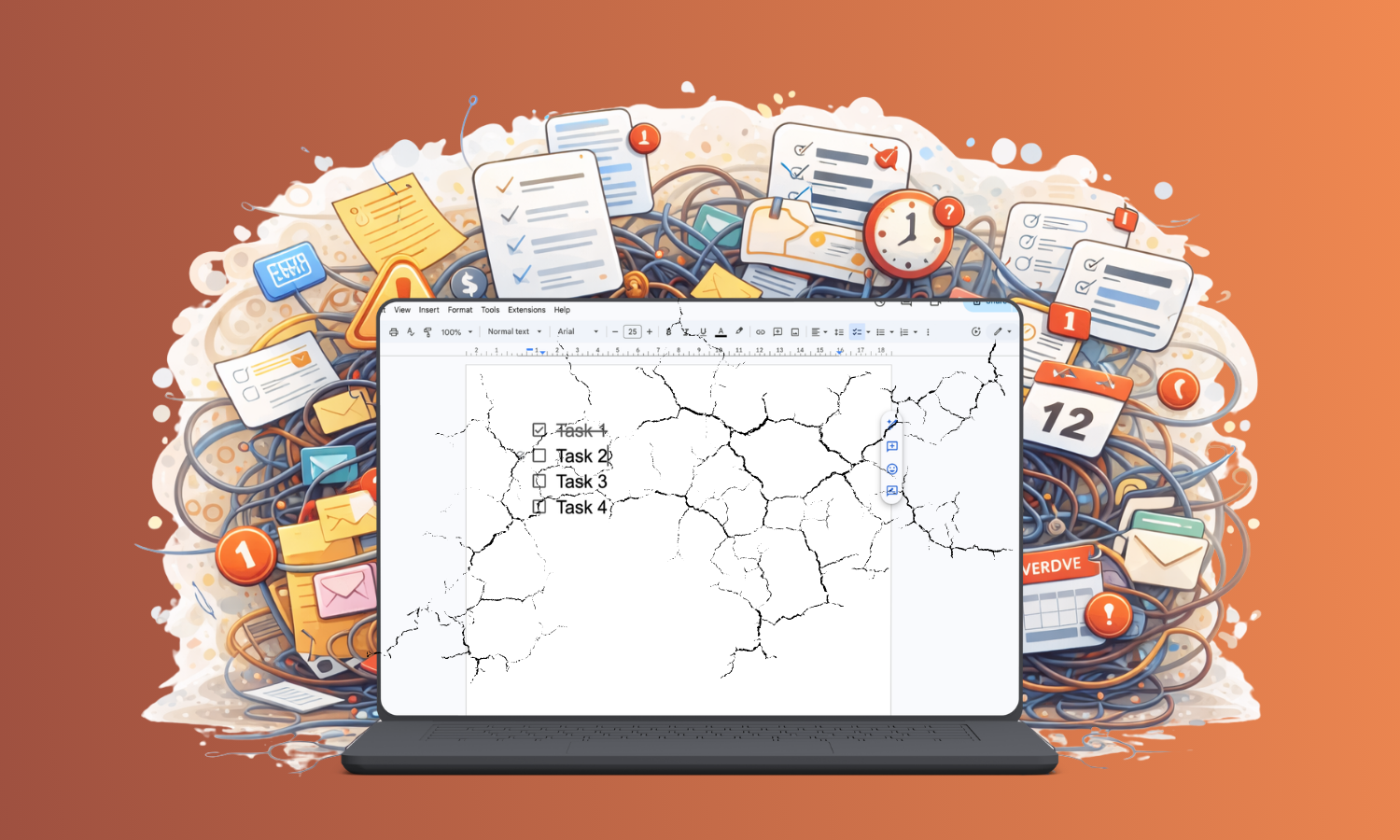
Action items scattered throughout documents with no tracking. Team members man**lly scrolling to find tasks among 15+ other items, then dragging them to the bottom when complete. No automated reminders. No visibility into what was overdue unless someone happened to open that specific client's document.
This is the expensive simplicity trap: when the tools your clients love are the same tools sabotaging your operations.
The real cost of familiar tools
Here's the uncomfortable math: 70% of workers report that lack of collaboration tools hampers their productivity, yet 44% of project managers still hesitate to adopt proper project management software.
The business we consulted with had reached this exact inflection point. They needed to create what they called a "world-class experience" for customers. But Google Docs — designed for document collaboration, not task management — couldn't support that vision.
Google Docs doesn't send reminders. It can't filter by status or assignee. It won't automatically notify anyone when tasks are overdue. These aren't limitations; they're fundamental design realities. You're using a word processor to manage a database.
That's like using a hammer to drive screws. Sure, it works if you try hard enough. But there's a reason screwdrivers exist.
What "simple" actually costs
Businesses confuse interface simplicity with operational simplicity. Everyone knows how to type in a Google Doc. That feels accessible, democratic, user-friendly.
Operationally? It's chaos.
Consider what actually happens with these "simple" solutions:
Someone completes a task but forgets to update the status. No one notices for a week. The client wonders why there's no follow-up. Your team scrambles to figure out what's actually done.
A task is due tomorrow. Nobody knows except the person who happened to write it down. No automated reminder. No dashboard showing what's at risk. Just institutional knowledge and hope.
You have five clients and 50 active tasks. To see which tasks are assigned to a specific team member, someone must man**lly open five different documents and scan through them. Every single time.
Workflow management software saves employees an average of 498 hours per year. That's not just productivity gains. That's the compound cost of fighting your tools instead of using them.
Where the hidden costs accumulate
The real expense of "simple" solutions shows up in places you're not measuring:
Time your team spends on man**l tracking instead of client work. Someone on your team just spent 45 seconds dragging a completed task to the bottom of a document. Then they opened another client's file and did it again. Fifteen times in one afternoon — 11 minutes of pure administrative overhead. Not client work. Not strategy. Just moving digital paper from one pile to another.
Action items that slip through the cracks. The business we worked with had a pricing model built heavily on coaching. Their model required staying close to client progress, knowing immediately when something was blocked or overdue. Man**l checking meant they were always one step behind. The clients who needed the most support were the easiest to miss.
The scalability ceiling you hit. Adding more clients means exponentially more man**l overhead. What works adequately at 10 clients becomes unwieldy with 20 clients and breaks completely at 30 clients. Only 22% of new businesses successfully scale over a decade, often because their operational systems can't keep pace with growth.
You can't see these costs on a line item. There's no invoice for "hours spent man**lly managing tasks that should be automated." But those hours add up to thousands of dollars in opportunity cost.
The compound effect of inadequate systems
The pattern is predictable: businesses choose simple tools, then spend years building increasingly complex processes around those tools' limitations.
They create man**l checklists to remember what the system can't track. They build spreadsheets to aggregate data that should already be centralized. They institute weekly review meetings to catch things that should be automatically surfaced.
All that complexity doesn't disappear when you choose simple tools. It just moves from the system into your processes.
Organizations waste 12% of their valuable resources due to poor project management. The sophistication you're avoiding in your tools is just sophistication you're building into your processes instead. And process complexity is harder to maintain, harder to scale, and exponentially more expensive than software complexity.
Teaching your clients bad habits
The business we consulted with initially worried about two things: the learning curve for clients and the cost of client portal systems. The pricing model of the tool we were looking at for them charges per guest user — about eight dollars per active client. Not nothing.
But here's what they realized: teaching clients to manage their business through Google Docs doesn't just create problems for you. It creates problems for them.
You're modeling a workflow that won't scale with their growth. Six months from now, they'll be the ones drowning in documents, wondering why they can't keep track of what needs to get done.
When you force inadequate tools to do jobs they weren't designed for, you're not being scrappy or lean. You're normalizing dysfunction.
What the right tools actually provide
Instead of clients digging through long documents to find their action items, they log into a portal that shows only their tasks. Filtered by status. Sorted by due date. With automated reminders three days before anything is due.
Instead of your team checking 15 different documents to see what's overdue, they see a dashboard that surfaces exactly what needs attention. Color-coded by priority. Grouped by client.
Instead of man**lly updating task statuses during calls, the system automatically moves items through stages as work progresses. When a client marks something complete, you get notified. When something is overdue and still not started, both of you get a reminder.
That's not adding complexity. That's removing it.
Companies using project management tools complete 61% of their projects on time, compared to just 41% for those not using such tools. The right tools don't add complexity — they absorb it.
The question isn't whether to change
The question is whether your systems will scale with you or hold you back. Every man**l process that works adequately at 10 clients becomes a nightmare at 20.
The real cost wasn't the portal fee or the temporary discomfort of learning something new. The real cost was the hours their team spent man**lly tracking tasks, the client action items that fell through the cracks, the opportunities missed because nobody had visibility.
Your "simple" solution isn't saving you money. It's costing you thousands in ways that don't show up on expense reports.
The distinction that matters
Keep Google Docs for what it does well: collaborative strategy documents, session notes, frameworks clients reference repeatedly. Those things genuinely benefit from the familiarity and ease of Google Docs.
But task management? That deserves its own system. One that actually does the job instead of requiring constant man**l intervention.
The right system gives everyone clarity: clients see exactly what they need to do, your team gets automated reminders for overdue items, and you can actually track what's happening across all your projects without opening 47 tabs.
That's not asking too much. That's just good business operations.
The tool your clients love isn't always the tool your clients need. And the temporary discomfort of learning something new is nothing compared to the permanent discomfort of fighting against inadequate systems.
Simple tools feel practical right up until you realize you're spending more time fighting them than using them. Choose tools that can handle the complexity you already have, not tools that force you to pretend that complexity doesn't exist.
.png)
.png)
.png)


