
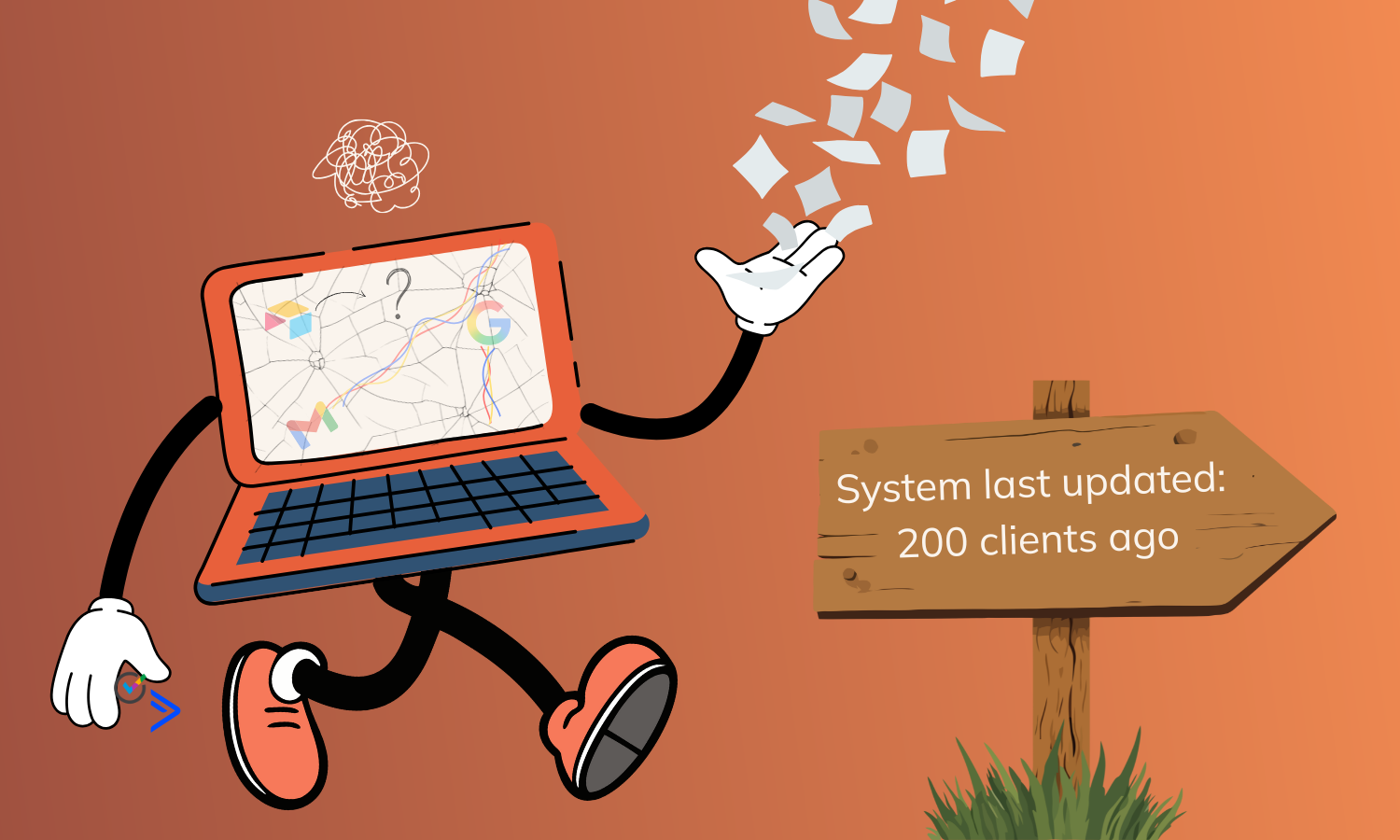
Growing businesses face a peculiar problem: the systems that got them to their current success often become the biggest obstacles to their next level of growth. What starts as an elegant solution eventually transforms into a productivity-killing monster that consumes time, frustrates teams, and creates more problems than it solves.
The "temporary" solution that became permanent
A successful service business built their entire operation around a basic CRM setup in ClickUp. Initially, this made perfect sense. They needed something simple to track leads, set follow-up reminders, and manage basic customer information. The system worked beautifully when they had dozens of contacts and straightforward workflows.
But success has a way of exposing system limitations.
As their customer base grew into the hundreds and their services became more complex, the man**l processes that once felt manageable started consuming hours of administrative time daily. Critical follow-ups began falling through cracks. Customer information scattered across multiple locations. Team members duplicated efforts because visibility was limited.
The tool that once enabled growth had become a growth constraint.
Why tool loyalty is expensive
Most businesses make the same mistake: they stick with familiar systems instead of choosing tools that match their current operational reality.
This business discovered they actually needed three distinct operational processes:
- Lead management and sales workflows
- Service delivery and project coordination
- Customer communication tracking across team members
Their single-tool approach was forcing workarounds that created cascading inefficiencies. Each workaround required additional man**l steps, increased the chance for errors, and made training new team members more complex.
The breakthrough came when they recognized a fundamental truth: the right tool depends on current needs, not past investments or familiarity.
The email integration game-changer
One requirement emerged as non-negotiable during their system evaluation: complete email communication tracking within the customer management system.
When team members send emails to customers, those conversations must be visible to anyone who might interact with that customer later. This eliminates the need for man**l updates like "sent follow-up email on Tuesday" and ensures consistent customer service regardless of who handles the interaction.
This single requirement eliminated several potential solutions and demonstrated why proper requirements gathering matters more than feature comparison charts.
When simple requests hide complex needs
What appeared to be a straightforward ticketing system actually required sophisticated technical architecture:
- Different permission levels for office staff versus field technicians
- Automated time-based calculations for service billing
- Real-time scheduling coordination across multiple team members
- Integration with accounting software for seamless invoicing
- Parts ordering and inventory tracking workflows
The lesson: operational simplicity often requires technical complexity. A basic request like "track service hours and generate invoices" involves database relationships, user interface design, automation rules, and integration protocols that multiply implementation requirements exponentially.
The expertise versus time equation
This business had someone building their website internally. Six months later, it remained unfinished. The intended cost savings were completely offset by delayed revenue opportunities and continued operational inefficiencies.
This pattern repeats constantly across growing businesses: attempting to save money through internal implementation often costs significantly more in opportunity costs and extended timelines.
The math is straightforward: if fixing operational inefficiencies could save 10 hours per week of team productivity, delaying implementation by six months costs approximately 260 hours of lost efficiency. At even modest hourly rates, this far exceeds the cost of professional implementation.
The compound effect of small improvements
Consider the impact of systematic efficiency gains: one business eliminated a 20-minute man**l onboarding call and reduced file search time by organizing information systematically. This saved three hours per customer interaction.
For a business serving 10 customers monthly:
- 30 hours saved per month
- 360 hours saved annually
- Equivalent to gaining a part-time team member's capacity
Scale this across larger customer volumes and the productivity gains become exponential rather than linear.
The planning paradox
The most valuable investment often isn't new technology—it's the clarity that comes from thoroughly understanding operational requirements before selecting solutions.
Proper consultation that maps current processes, identifies specific pain points, and defines future scalability needs prevents expensive false starts. The upfront investment in planning typically saves multiples in implementation costs and post-launch modifications.
More importantly, it ensures systems support growth rather than constrain it.
Red flags that your systems need attention
Your current tools might be holding you back if:
- Team members frequently ask "where do I find..." or "how do I update..."
- The same information gets entered in multiple places
- Follow-ups and important tasks regularly fall through cracks
- New team member training takes weeks instead of days
- You avoid taking on new projects because current processes can't handle the volume
- Customer communications happen outside your main system
- Reporting requires man**l data compilation from multiple sources
Moving forward strategically
System transformation doesn't require rebuilding everything simultaneously. The most effective approach involves:
1. Process mapping: Document current workflows completely, including all the workarounds and man**l steps that have evolved over time.
2. Pain point prioritization: Identify which inefficiencies cost the most in time, money, or customer satisfaction.
3. Requirements definition: Specify non-negotiable system capabilities before evaluating tools.
4. Implementation planning: Phase changes to minimize disruption while maximizing early wins.
5. Team preparation: Ensure adequate training and support during transitions.
The goal isn't perfect systems—it's operational clarity that enables sustainable growth.
The bottom line
Your business systems should be invisible enablers, not daily obstacles. When team members spend more time managing tools than serving customers, it's time for systematic change.
The cost of maintaining inadequate systems compounds daily. The sooner you address operational constraints, the sooner your team can focus on the work that actually grows your business.
Day By Day partners with scaling businesses to create clarity and structure in operations, designing tailored workflows that enable intentional growth.
%20(1).png)
.jpg)


