
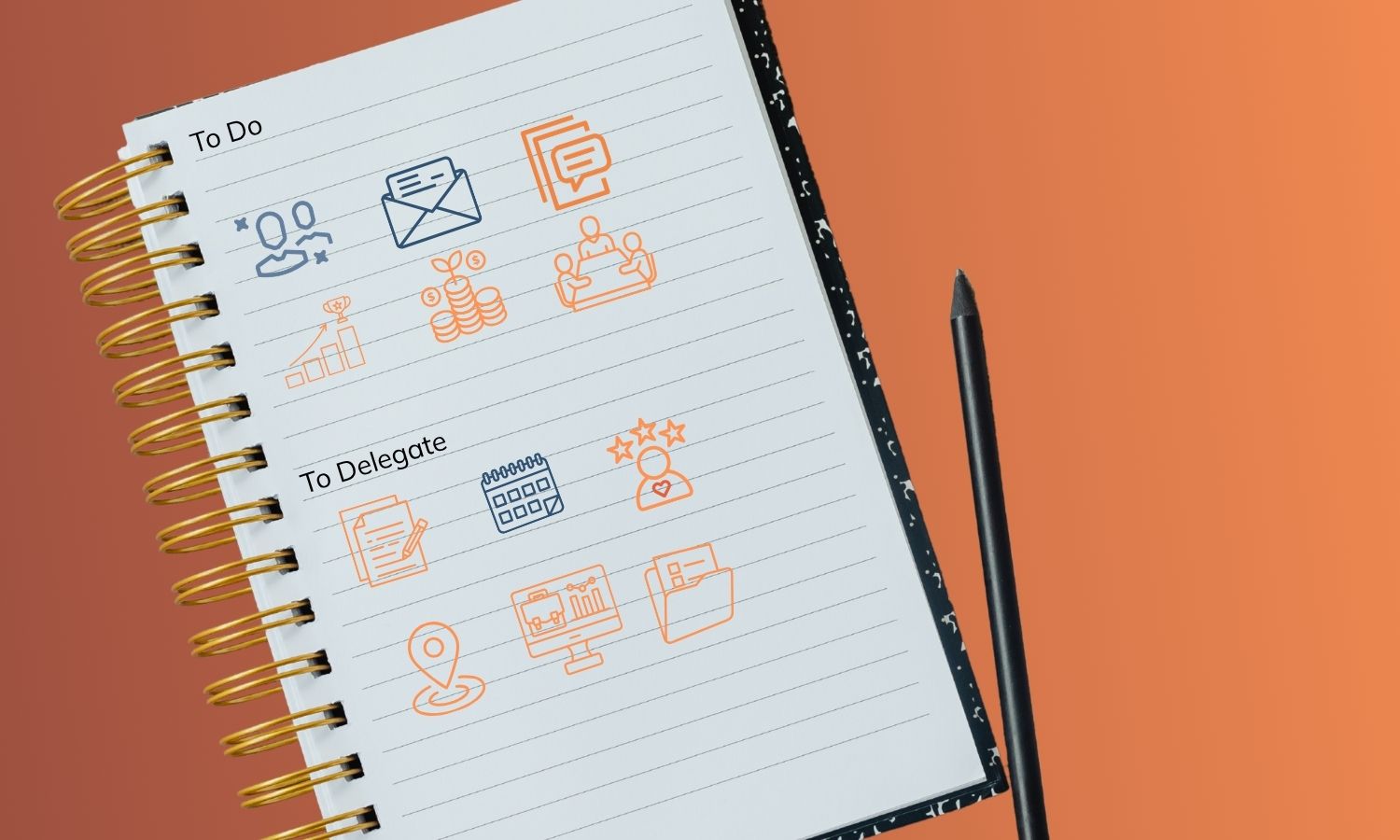
Most service business owners reach a point where the volume of work exceeds what one person can reasonably handle. Emails and projects pile up, and the founder becomes the bottleneck for everything. The solution everyone recommends is delegation. But knowing that you should delegate and knowing how to delegate are two very different things.
So, how do you approach effective workplace delegation? With a combined 15 years in SaaS leadership and operations consulting at Day By Day, I’ve seen what happens when a leader tries to do all the work, and what a difference delegating can make. Let’s look at how to figure out what to hand off and how to build the conditions that make delegation stick.
Key Takeaways on Delegating Effectively
- Effective delegation starts with mapping your own process before assigning anything to anyone.
- The benefits of delegation directly support team growth and business capacity.
- Delegation skills include communication, trust-building, and follow-through, not just task assignment.
- The most common delegation challenges stem from mindset: “I’ll do it faster myself.”
- Learning how to delegate as a leader involves trusting your team to handle the work while staying clear about what “good” looks like.
What Are the Benefits of Delegation?
Done right, delegation is the upgrade that boosts productivity and strengthens your team’s skills without overloading you, as the leader.
It’s worth grounding yourself in this knowledge, especially if you’re a founder who’s been running everything yourself and is understandably cautious about handing things off.
Research from Gallup following 143 CEOs on the Inc. 500 list found that the most effective leaders consistently delegated more than their peers, and those businesses generated stronger revenue growth as a result. The key finding: founders with strong delegation skills can build better business outcomes than those who stay buried in day-to-day tasks.
The benefits of delegation go further than just freeing up your time, you start to see effects like these:
- Team efficiency improves when people are matched to tasks that suit their strengths. When the right work lands with the right person, it moves faster and with fewer errors.
- Employee motivation increases when team members are given real responsibility. The Journal of Economics and Business found a positive correlation between effective delegation and employee performance. The bottom line: people who are trusted with meaningful work tend to perform better and stay more invested in outcomes.
- Leaders can focus on what actually matters. Every hour you spend on tasks that someone else could handle is an hour not spent on client relationships or in your zone of genius.
- Delegation makes your business more resilient. When knowledge and responsibility live in one person's head, the business is fragile. Spreading decision-making and task ownership across a team makes the operation easier to sustain.
Getting Started with Delegation
What are the first steps to take when you start delegating? Begin with these practical steps:
Decide What Should Leave Your Plate
The first step in learning to delegate work effectively is understanding your own process. You cannot hand something off if you haven't mapped it out.
Start by writing down every step involved in a recurring area of your work - client onboarding, project delivery, content creation, sales follow-up, whatever consumes the most of your time. Go granular. Tasks that feel like they "only take a minute" still take your time and your attention, and that matters when you're managing at scale.
If writing it out feels difficult, try recording yourself walking through the process. Watching it back often reveals steps you'd forgotten you were doing. Not sure where to even begin? A business process consultation can walk you through it.
Delegating to a Team Member
Once you have a full picture of your process, ask yourself: which tasks genuinely require my relationships or my expertise? And what is a well-defined task that someone else could execute with the right context?
A useful framework for sorting this out is the Eisenhower Matrix, which organizes tasks by urgency and importance. Tasks that are important but not urgent, and don't require your specific expertise, are often strong candidates for delegation. For a deeper look at this decision-making process, you can dive into this detailed breakdown of knowing what to delegate.
Delegating to a Tool
It may also be worth considering which tasks could be delegated to an automation instead of a person. Repetitive, rule-based steps, like creating a project record when a client signs a contract or sending a follow-up email after a booking, are often better handled by a tool than a team member.
Select the Right Person for the Job
Matching the task to the person matters enormously. Effective delegation is more about understanding your team members' talents than offloading whatever you don't want to do onto whoever is available. It’s important that you know where each person is motivated to grow.
Look at the nature of the task. It will often fall into one of 3 categories:
- Is it detail-oriented, requiring consistency and accuracy?
- Is it client-facing, requiring judgment and communication skills?
- Is it technical, requiring specific knowledge?
Then look at your team members honestly. Who has demonstrated the capability, or would be excited to grow into the role? When you're delegating tasks to someone who is newer or still building confidence in an area, consider starting small. Give them one clear, contained task and see how it goes. That way, you both get a feel for working together before you hand over something bigger.
If you don't yet have a team, this mapping exercise is still valuable. Tag tasks by the type of role (VA, designer, bookkeeper) rather than based on a specific person. When you hire, the role definition is already built from your actual process rather than guesswork.
Tips for Delegating: Setting Your Team up for Success
Delegation works best when people know exactly what they’re aiming for. These steps set your team up to take ownership with confidence.
Be Clear About Your Expectations
One of the most common reasons delegation breaks down is that the expectations were never fully communicated in the first place. The person doing the task may have understood the what but not the why, and so they made decisions that didn't align with what you had in mind.
When assigning a task, cover what the finished result looks like, when it's needed, what level of autonomy the person has to make decisions, and when they should come back to you with questions versus pressing forward. Writing this down makes the work clearer and creates a reference point if things get off track.
Give Them Everything They Need
A task handed off without the tools or context to complete it will come back to you anyway. Before delegating, make sure the person has access to what they need. This might include the right software and documents, or the client's background.
This step is particularly important when you're delegating something for the first time. A lot of what you “just know” from experience only shows up as real knowledge when you try to teach it. Building a simple written process or walkthrough video for recurring tasks is one of the highest-leverage investments you can make in your team's ability to operate without you.
Build Trust from Day One
People do their best work when they feel genuinely trusted. If your team senses that every delegated task comes with constant check-ins and corrections, they will stop taking initiative.
Trusting in your team is a decision you make based on evidence. Start with lower-stakes tasks, and provide support and feedback as you go. As the trust builds, you can hand over more autonomy.
One pattern worth watching for is when the people most resistant to receiving delegated work are your most capable team members, particularly those who've developed workarounds for limitations in your current systems. They know where the edges are. If you're getting pushback, it may be a signal that the task itself needs some work.
Check In Without Micromanaging
There's a real difference between appropriate oversight and micromanagement, and it's important to be sure you’re not crossing the line.
Appropriate oversight means agreeing on check-in points in advance with clear milestones in place, and being available when your team has genuine questions. Micromanaging means revisiting decisions that have already been made and checking in so frequently that the person can't build momentum.
A useful question to ask yourself before following up: Is this check-in for me, or for them? If you're following up because you're anxious rather than because the task genuinely needs a checkpoint, that's worth noticing.
Raise the Bar With Honest Feedback
Delegation doesn't end when the task is complete. Closing the loop with feedback, both when things go well and when they don't, can turn a one-time handoff into a learning system.
Specific, timely feedback gives your team members the information they need to improve and builds the kind of working relationship where they're comfortable raising issues before they become problems. Recognized effort also shows that delegation is about their growth as much as it is about your workload.
Why You May Be Sabotaging Your Delegation Efforts
Is your delegation stalling? It’s usually not your team; it’s the expectations you may not have noticed. See if any of these sound familiar.
1. "It's faster if I do it myself"
This is almost always true in the short term. But it ignores the compounding cost of never building up your team members. Every time you bypass delegation to save ten minutes, you're spending an hour next week, and an hour the week after that, doing the same thing alone.
Think of it like teaching your kids to do the dishes. Sure, you may have to redo one or two of them at first, and sure, it may take more time. But after a while, it’s not you staring down that sink of dishes from the family dinner you hosted, it’s one of them 😉 And down the road, you’ve just given your child a skill that will serve them. Your employees are no different.
2. Fear of losing control
This is one of the most common obstacles to learning how to delegate as a leader, and it's also the most understandable. You've built something huge, and you care deeply about how it runs. The shift is this: when you delegate well, you’re not giving up control. You’re increasing how much you can influence at the same time.
If we go back to the kids washing dishes example, once your child knows how to wash dishes, you can be doing something else while they do them. You’ve now expanded your capacity to 2 tasks rather than just one. And the sooner you teach your child your standards for washing dishes, the easier it will be to let go of control.
3. Lack of trust in the team
Sometimes this is about the team, but more often, it's about the system. If you don't have documented processes or a way to spot problems before they escalate, it's rational to be nervous about handing things off. The solution isn't to hold everything yourself; it's to build the infrastructure that makes delegation reliable.
4. Not knowing how to start
Workplace delegation can feel overwhelming when it's framed as an all-or-nothing shift. It isn't. Start with one task, one person, one well-documented process. Build from there.
Case Study: How Netflix Used Delegation to Scale
A useful example of delegation in business management at scale is how Netflix structured its operations during its early growth phase. Instead of keeping all the decisions at the top, they hired people they trusted to think for themselves, and then actually let them. Leaders focused on giving clear direction and context, not hovering over every call.
This can apply directly to smaller service businesses: the goal of delegation isn't to create a system where everything still runs through you. It's to build a team and a set of processes where people have enough context and authority to do good work without you in the room.
Start Delegating and Scale Your Impact
Learning to delegate effectively is one of the most practical ways a scaling service business can make room for growth. Unfortunately, it’s commonly avoided because it requires mapping your own process and building trust with your team. It also means you must be honest with yourself about which tasks you're holding onto out of genuine necessity versus discomfort.
The payoff of delegating is massive. When the founder is not the bottleneck for everything, the business can serve more clients and grow without the same constraints. Excellent delegation skills are what make that possible.
If you’re struggling with delegation and still carrying more than you should, you’re not alone. I’ve helped many founders clarify what to hand off and how to do it, so they can stay in their zone of genius and strengthen their team. Hop on a call with me, and we’ll start putting the right systems in place.
FAQs About Effective Delegation
Why is it important to delegate?
Delegation allows leaders to focus on the work only they can do while developing their teams capacity and skills. Without it, business growth creates a bottleneck at the founder level rather than distributed capability across the organization.
What are the 5 Cs of delegation?
The 5 Cs of delegation are Clarity (be specific about what you're asking for), Capability (match the task to the person's skills), Commitment (confirm the person is genuinely on board), Communication (stay accessible without hovering), and Completion (close the loop with feedback when the task is done).
Why do I struggle to delegate?
Most delegation challenges come down to three things: not trusting the outcome, not having documented processes to hand off, or simply not having mapped out what the task actually involves. All three are solvable, but they require some upfront investment before the delegation itself.
How to delegate without losing control?
To delegate without losing control, you must define the outcome you're responsible for, then give people room to decide how they get there. Stay connected through agreed-upon checkpoints rather than continuous oversight. Over time, strong team members build track records that make it easier to extend trust further.
How to delegate without being bossy?
Focus on outcomes and context when delegating, rather than step-by-step instructions (where possible), to avoid coming across as bossy and micromanaging. Explain the why behind what you're asking for, and invite questions. When you're assigning work to someone capable, giving them room to bring their own thinking to the task usually produces better results than prescribing exactly how it should be done.
%20(1).png)
.jpg)


